How an LED Display Can Transform a School Gym: A Technician’s Perspective
Hi, my name is Artur. I’m the main LED display technician at
Canadian LED.
Over the years, I’ve worked on real installations in corporate venues,
event stages, churches, community centers, and increasingly, schools.
School gyms are some of the most challenging — and rewarding — spaces to work in.
They’re loud, active, multi-purpose, and often used far beyond regular school hours.
When a school decides to upgrade its visual system, it’s rarely about “just a screen.”
It’s about visibility, durability, flexibility, and long-term value.
In this article, I want to walk you through what really changes when a school gym
replaces a traditional projector with an LED display —
based on real installation experience, not marketing theory.
Why School Gyms Are Moving Away from Projectors
Almost every school gym I’ve worked in started with the same setup:
an aging projector, a pull-down screen, and constant complaints.
The problems are almost always the same:
The image is too dim during daytime
Bulbs burn out frequently and are expensive
The picture looks washed out from the sides
Maintenance becomes a yearly headache
A gym is not a controlled environment. Lights are on, sunlight comes in,
people move constantly, and events change every day.
Projectors were never designed for that reality.
This is where modern LED displays start to make sense —
not as a luxury, but as a practical upgrade.
What Makes an LED Display Different in a Gym Environment
From a technical point of view, the biggest difference is
brightness and consistency.
An LED display produces its own light.
It doesn’t rely on reflecting an image off a surface, which means the picture stays clear
no matter where you’re standing or how bright the room is.
But there’s more to it than that.
In a gym, the display usually needs to serve multiple purposes:
Live scoreboards during games
Announcements and schedules
Assemblies and presentations
Community events and rentals
Occasionally, even movie nights
One LED display replaces multiple systems at once.
Choosing the Right Size: Bigger Isn’t Always Better
One of the most common questions I get is:
“How big should the display be?”Bigger isn’t always better.The right size depends on three things:
Viewing distance
Wall space and structure
Budget
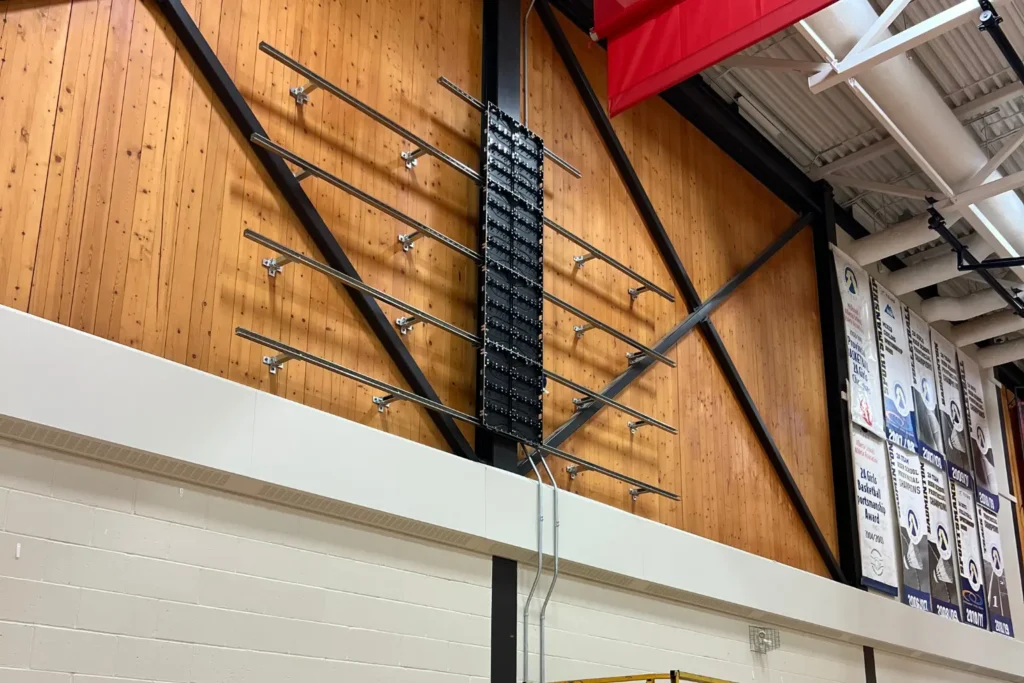
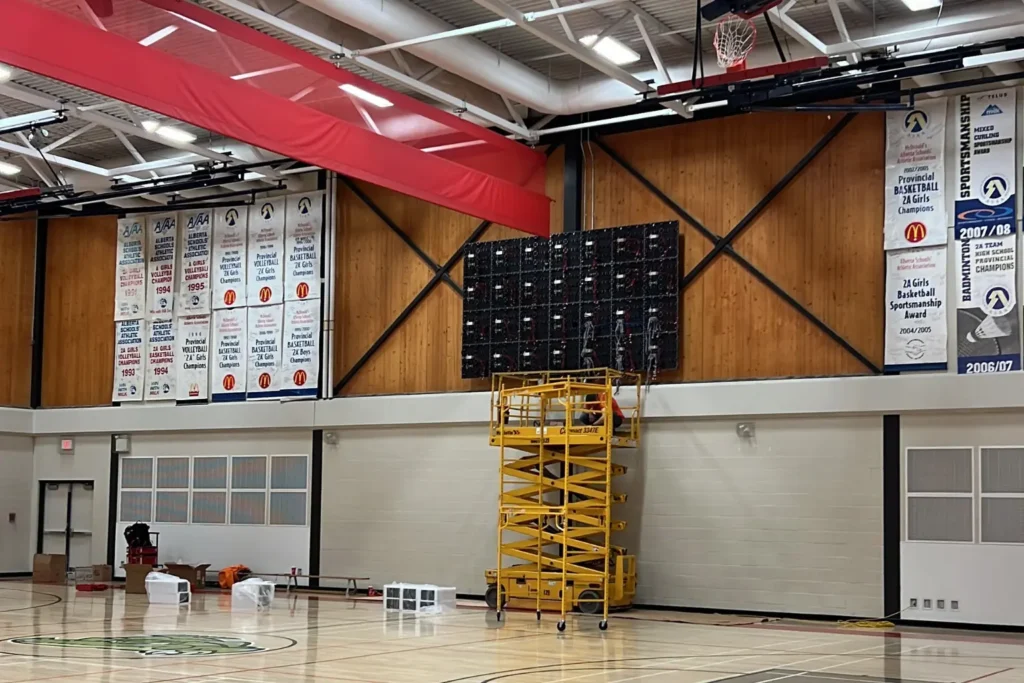
In one Alberta school gym we worked on recently, we installed a
15 × 8 ft indoor LED display.
From a technician’s perspective, that size was a good balance:
large enough to be clearly visible from the bleachers, but not so large
that it dominated the space or required major structural changes.
Oversizing a display creates unnecessary costs — not only for the panels themselves,
but for mounting, power, and processing.
How We Install LED Displays in School Gyms
Every gym is different, but the installation principles stay the same.
1. Planning Comes First
Before anything is mounted, we evaluate:
Wall structure and load capacity
Power availability
Cable routing
Viewing angles
Planning comes first. This step prevents surprises later.
2. Pre-Assembling the Panels
Whenever possible, we pre-assemble LED panels on the ground. This allows us to:
Check alignment
Test image consistency
Reduce installation time at height
Once panels are lifted, everything should already fit perfectly.
3. Mounting and Calibration
Panels are mounted one by one, then calibrated for color, brightness, and uniformity.
This part is invisible to the audience — but it’s where quality really shows.
Durability: One of the Biggest Concerns in Gyms
Gyms are high-impact environments. Balls fly. Equipment moves. Accidents happen.
That’s why durability matters just as much as image quality.
For school gyms, we often use LED modules with an additional epoxy coating.
This adds protection to the LED surface without affecting image clarity.
In most cases, there’s no need for external protective glass.
The display itself is built to handle real-world use.
Beyond Sports: How Schools Actually Use LED Displays
The display quickly becomes part of everyday school life.After installation, schools use the display for:
Morning announcements
Award ceremonies
Guest presentations
Parent meetings
Community rentals
Some schools tell us the display paid for itself faster than expected.
This flexibility is why many administrators see
LED displays for schools
as a long-term infrastructure upgrade.
Watch the Installation in Action
Here you can see how a typical school gym LED display installation comes together —
from pre-assembly to final calibration.
Final Thoughts from the Technician’s Side
The best feedback I get is not about resolution or pixel pitch.
When teachers tell me, “It just works,” I know the project was successful.
An LED display doesn’t change how a school teaches.
But it does change how clearly information is shared.
When planned correctly and installed professionally, an LED display simply blends
into daily school life — while quietly improving every event it supports.
If you’re exploring options for a school gym, focus on
real use cases, durability, and long-term value. The rest will follow.
— Artur
Main LED Display Technician